The Beginner's Trap
Learning Tools Without Solving Problems — why collecting courses won't make you a data scientist, and what actually will.
"Why collecting courses won't make you a data scientist — solving real problems will."
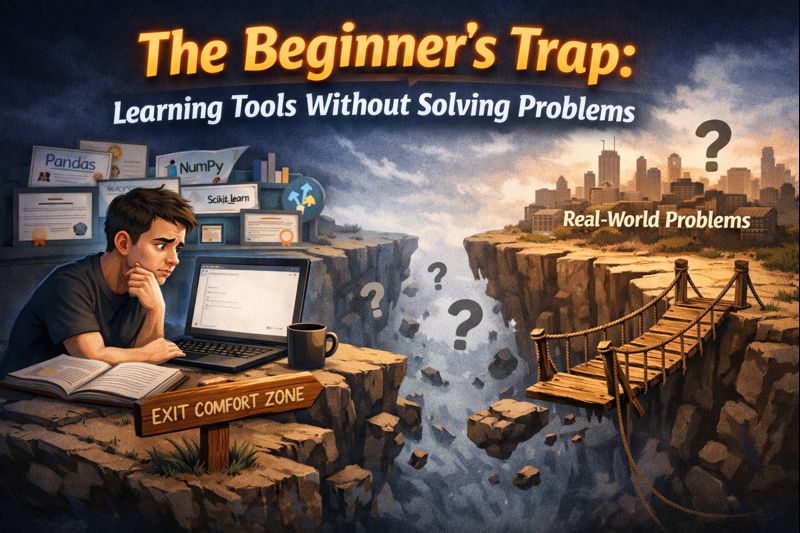
There's a peculiar phenomenon I've observed countless times in the data science community (and in myself). An eager newcomer posts their learning journey on LinkedIn: "Just completed my 15th Pandas course!" or "Finished another NumPy tutorial today!". They've accumulated certificates like trading cards, yet when faced with a real dataset, they freeze. The cursor blinks on an empty Jupyter notebook, and despite hundreds of hours of "learning," they don't know where to start.
This is the beginner's trap, and it's more common than you might think.
The Tool Collector's Fallacy
When I started my journey as a data scientist, I often used to think — and sometimes still do — that collecting tools without solving problems is a good approach. Instead of actually learning, I became a "tool collector". Similar to that, new aspiring data scientists are bright, motivated individuals who can recite Scikit-learn functions from memory and explain the difference between loc and iloc in Pandas with impressive precision. They've watched every YouTube tutorial, completed multiple MOOCs, and can discuss regularization techniques over coffee.
But ask them to analyze a messy CSV file of actual business data, and something breaks down.
The problem isn't their intelligence or dedication. It's that they've been learning syntax when they should have been learning to think. They've memorized the tools without understanding when, why, or how to use them.
Python Libraries vs. Real Use Cases: The Gap
Let's be specific about what this gap looks like in practice.
What courses teach you:
- How to use pd.read_csv() to load data
- The syntax for groupby() operations
- How to create a basic matplotlib plot
- The parameters for train_test_split()
What real projects demand:
- Figuring out that your CSV is actually semicolon-delimited and has inconsistent encoding
- Realizing you need to group by multiple columns, handle missing values first, and that your date column is formatted incorrectly
- Understanding that your stakeholder needs an interactive dashboard, not a static plot, and the story matters more than the visualization
- Deciding whether you even need a train-test split, or if your time series data requires a different validation approach entirely
The difference is profound. Courses teach you to use tools in controlled environments with clean data and clear instructions. Real problems are messy, ambiguous, and require you to make dozens of small decisions that no tutorial prepared you for.
Let's say you completed three separate courses on machine learning. When tasked with predicting customer churn, you spend two weeks trying to decide which algorithm to use, paralyzed by options. What no course taught you was that the algorithm choice often matters less than feature engineering, data quality, and understanding the business context. Those skills only come from doing.
Why Projects Matter More Than Courses
Projects force you to confront a reality most educational content avoids: there are no clear answers, and the path forward is rarely obvious.
When you work on a real project, several critical things happen that never occur in a course:
- You learn to ask the right questions. Courses give you the question. Projects require you to figure out what question even matters. Should you predict next month's sales or identify which products are trending? The framing of the problem often determines the success of the solution.
- You encounter real messiness. That beautiful dataset in the course? It doesn't exist in the wild. You'll find missing values not marked as NaN, dates in six different formats, text fields filled with numbers, and categorical variables with 847 unique values.
- You're forced to make decisions without perfect information. Should you impute missing values or drop them? Is this outlier an error or important information? Which features actually matter? These judgment calls, made hundreds of times per project, build the intuition that separates competent practitioners from perpetual students.
- You learn to iterate and fail. Your first approach will be wrong. Your model will perform poorly. Your visualization will confuse people. This cycle of attempting, failing, learning, and trying again is where real growth happens.
- You build something tangible. There's a profound difference between following along with a tutorial and creating something from scratch. One exercises recognition, the other demands recall and creativity. When you finish a project, you have something you can show, explain, and be proud of.
The Right Way to Learn
I'm not suggesting that courses and tutorials have no value. They're essential for building foundational knowledge and understanding what tools are available. But they should be the beginning of your learning, not the end.
Here's what I recommend to every beginner — including myself:
- Start with a problem that interests you. Not someone else's Kaggle dataset with a clear target variable. Your problem. Maybe you want to analyze your city's crime patterns, predict your favorite sports team's performance, or understand trends in your industry. Genuine curiosity will carry you through the difficult parts.
- Learn tools as you need them. When your project requires you to merge datasets, that's when you learn Pandas joins properly. Context creates sticky knowledge. The function you learn because you desperately need it will stay with you far longer than the one you memorized from a course.
- Embrace the struggle. When you're stuck, frustrated, and Googling error messages at midnight, you're learning. That discomfort is the feeling of your brain building new pathways. Courses feel productive because they're smooth and easy. Projects feel hard because they are — and that's exactly why they work.
- Build a portfolio, not a certificate collection. Three well-executed projects that solve real problems will open more doors than thirty course certificates. They demonstrate that you can take ambiguous problems and create valuable solutions — which is precisely what employers and clients need.
The Bottom Line
If you're serious about becoming a data scientist, at some point you need to close the tutorials and open a blank notebook. You need to find a messy dataset and a question that matters to you, then figure it out.
You'll struggle. You'll feel like you don't know what you're doing. Your code will be inefficient, and your first results will be disappointing.
The tools, libraries, and techniques are important, but they're not the goal. They're the means to an end. The goal is solving problems, creating value, and building things that matter. You can't learn that from a course.
So stop collecting certificates and start building. Your future self, looking back at your first completed project, will thank you.
Found this useful? Connect with me on LinkedIn — I share more data science content, tutorials, and insights regularly.